
What Fuel-System Cleaners Actually Do — and When Your Car Needs One
Over time, every petrol or diesel engine builds up deposits inside the fuel injectors, intake valves, and combustion chamber. These microscopic layers of carbon and varnish don't appear overnight, but once they accumulate they quietly rob your engine of power, fuel economy, and clean combustion. A quality fuel-system cleaner is the simplest way to dissolve them — without lifting the bonnet.
How Fuel-System Cleaners Work
A fuel-system cleaner is a concentrated additive you pour directly into the fuel tank. Its active chemistry — typically polyetheramine (PEA) or polyisobutylene amine (PIBA) detergents — travels with the fuel through the entire circuit: tank, fuel pump, filter, injectors, and into the combustion chamber itself.
Once there, the detergents break the molecular bonds that hold carbon deposits and lacquer varnish to metal surfaces. The loosened residue combusts harmlessly with the fuel or passes out through the exhaust. A single treatment can restore injector spray patterns close to factory spec, improving atomisation and the quality of the air-fuel mixture.
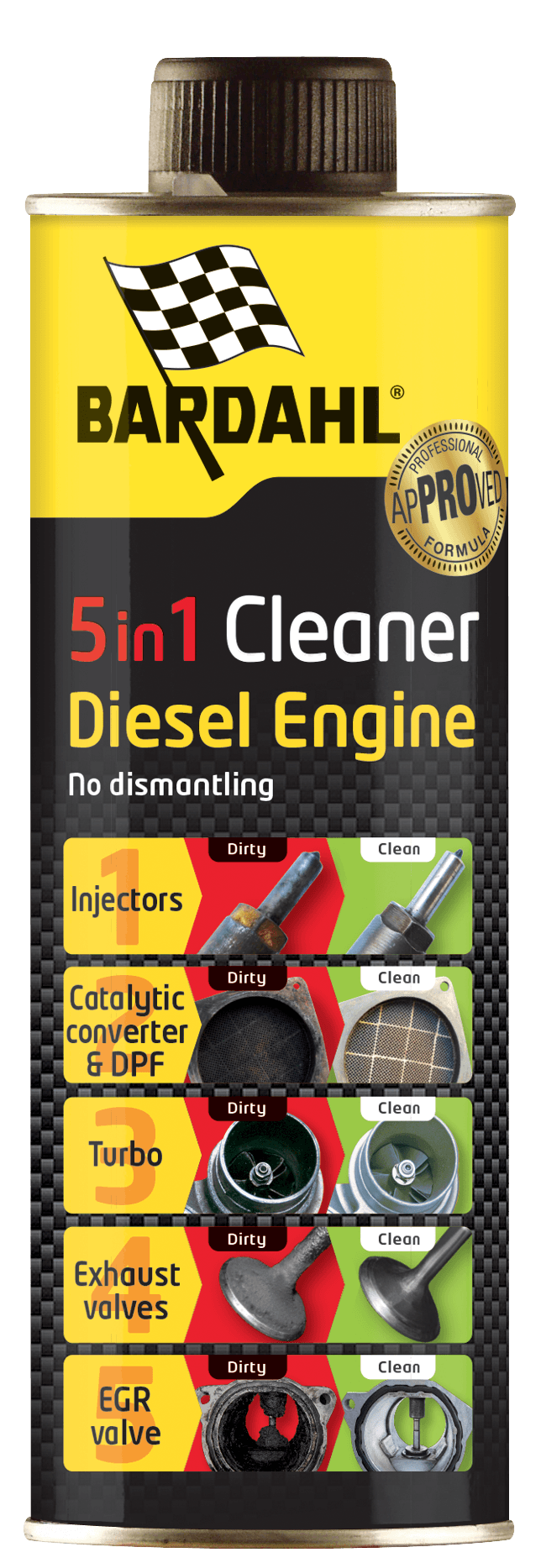
Products like Bardahl Fuel System Cleaner are formulated with high-concentration PEA to tackle even stubborn deposits on direct-injection engines — where carbon build-up on intake valves is a well-documented problem because fuel no longer washes them.
Signs Your Fuel System Needs Cleaning
You don't always need a diagnostic scanner to suspect dirty injectors. Watch for:
- Rough idle or engine hesitation at low revs
- Noticeably reduced fuel economy on the same routes
- Sluggish throttle response or flat spots under acceleration
- Difficulty starting, especially on cold mornings
- Increased exhaust emissions at the annual roadworthiness test (KTEO)
When and How Often to Use One
For most vehicles driven on typical Greek urban and motorway conditions, a preventive dose every 10,000–15,000 km is enough to keep the fuel system clean. If you predominantly do short city trips in Athens or Thessaloniki stop-and-go traffic, every 7,500–10,000 km is more appropriate — low-speed driving accelerates deposit formation.
Practical tips for best results:
- Add the cleaner to a nearly empty tank, then fill up — this ensures the correct dilution ratio and immediate circulation through the system.
- For a first treatment on a high-mileage vehicle with suspected heavy deposits, some mechanics recommend two consecutive treatments on successive fill-ups.
- Always use a cleaner rated for your fuel type: a petrol formulation used on a diesel engine (or vice versa) can damage seals and injector coatings.
- Bardahl offers dedicated formulations for petrol, diesel, and LPG vehicles, so matching the right product to your engine takes seconds.
Fuel-system cleaning is one of those preventive tasks that pays for itself in saved fuel and avoided repairs. A bottle added to the tank once or twice a year — combined with quality fuel and timely filter changes — costs far less than injector reconditioning or a premature engine overhaul. It is not magic; it is chemistry doing exactly what it was designed to do.
Need the right Bardahl products?
Explore the range